
Anopheles Mosquito
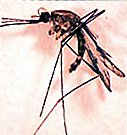
The Anopheles mosquito is known universally as the Malaria Mosquito species because it is considered the primary vector of the disease. It is also considered a transmitter of heartworm in dogs.
When resting, the stomach area of the Anopheles mosquito points upward, rather than being even with the surrounding surface like most mosquitoes.
Description | Breeding | Geography | Interesting Facts
Description
The Anopheles mosquito is known universally as the Malaria Mosquito species because it is considered the primary vector of the disease. Learn more about the symptoms of malaria. The Anopheles mosquito is also considered a transmitter of heartworm in dogs. This mosquito species seems to prefer mammals, including humans, for its blood meal.
The body of the adult Anopheles mosquito is dark brown to black in color and has 3 sections which are the head, thorax and abdomen. When resting, the stomach area of the Malaria Mosquito species points upward, rather than being even with the surrounding surface like most mosquitoes. The female Anopheles mosquito will mate several times in her short lifespan, producing eggs after she has found a blood meal. Although she only lives a few weeks to a month at most, she will have been able to produce thousands of eggs during that time.
The female mosquito will deposit up to 200 eggs individually onto the water’s surface. Each of the single eggs remains on the water by the use of floats. The eggs take anywhere from two days to three weeks to hatch, depending on the temperature of the region.
Larvae are known as wigglers since they seem to move in that manner. They lie parallel to the water’s surface in order to feed on fungi, bacteria and other tiny organisms. These larvae will undergo growth throughout the four instars of this stage, after which they become pupae.
Pupae are known as tumblers because of the way they seem to “tumble” through the water. Their rounded, comma-like shape makes this mode of movement easy. These pupae come to the surface of the water in order to breathe using tiny “trumpets,” but they do not eat during the 1-2 days in which they will become an adult mosquito. Learn about the malaria mosquito bite, as well as the malaria mosquito breeding cycle.
Breeding Habits
The female Anopheles mosquito will lay her eggs in a wide range of locations. Malaria mosquito breeding grounds include fresh water or salt-water, vegetative or non-vegetative, shady or sunlit. Ground pools, small streams, irrigated lands, freshwater marshes, forest pools, and any other place with clean, slow-moving water are all considered prime Malaria mosquito breeding grounds for egg-laying.
Females, particularly fertilized females, may survive winter by hibernating in caves, which means the malaria breeding cycle can virtually last year-round in some locations. Eggs are capable of surviving cold temperatures; however, freezing usually kills eggs. Learn about the malaria mosquito bite, as well as the malaria mosquito species.
Geography
Where do Malaria mosquitoes live? Anopheles mosquitoes can be found just about anywhere in the world with the exception of Antarctica. Since these mosquitoes can be found in places where malaria has been eradicated, there is always the chance that malaria can re-infest that area.
After all, it only takes one blood meal from a person or mammal infected with Malaria for the Anopheles mosquito to transmit it to another person or mammal. The person originally infected may have just travelled to an area where Malaria is present or an unsuspecting visitor from an endemic region may have brought the disease along on a visit. Learn more about the symptoms of malaria, as well as the malaria mosquito species.
With world travel so common today, the possibility of re-infesting a previously eradicated area always exists. In addition, regions that have never had outbreaks of malaria may become an endemic area for the first time. Where do Malaria mosquitoes live? Anywhere. Effective mosquito control systems can offer protection against these pests and their mosquito-borne diseases.
Interesting Facts
There are about 430 species of the Anopheles mosquito, but only between 30 and 40 of those mosquito species are actual vectors, or conveyors, of malaria.
Many of the Anopheles mosquito species have become resistant to insecticides through years and years of pesticide use.
Anopheles mosquitoes are most active at two times: just before dawn and right after darkness sets in. At these times of the day, outdoor mosquito control is important to provide protection against the malaria mosquito bite. Mosquito Magnet® offers effective solutions for dealing with this, and other types of mosquitos.
Shop Mosquito Magnet® Mosquito Traps »
The Anopheles mosquito can cause an outbreak of “airport malaria” when it is accidentally imported via luggage or even the airplane itself.
Sir Ronald Ross, who proved the transmission of malaria by the Anopheles mosquito, was not only a scientist; he was also a mathematician, novelist, poet, editor, composer, and artist.
The Anopheles mosquito is still found in many areas where malaria has been eradicated. Although the parasite has been eliminated, since anopheles mosquitoes are still present, it is still possible for malaria to be reintroduced into the area by a single Malaria mosquito bite.
Anopheles mosquitoes in an eradicated area can be infected by “introduced” malaria. When humans from eradicated areas travel to endemic areas, they may become infected by a Malaria mosquito bite by a mosquito that carries the disease. Upon returning home, the infected human is bit by an indigenous anopheles mosquito that then transmits it to other residents in the area. Learn more about the symptoms of malaria, as well as the malaria mosquito species.
 Protect your family, pets and guests from disease-carrying mosquitoes with a Mosquito Magnet® trap - the leading long-term, scientifically-proven mosquito control solution
Recommended Products
-
-
-
-
 Mosquito Magnet® Patriot Plus & 2-Month Accessory Bundle - ATRAKTA®Special Price $459.99 Regular Price $572.96
 -
 Mosquito Magnet® Executive & 2-Month Accessory Bundle - ATRAKTA®Special Price $899.99 Regular Price $1,110.96
