
FAQs - Diseases
Have Questions?
Find immediate answers to commonly asked questions, such as how long mosquitoes live, do mosquitoes transmit aids, can mosquitoes survive in cold climates and more.
Frequently Asked Questions about Eastern Equine Encephalitis
Q: Can people die from Eastern Equine Encephalitis here in the United States?
A: Yes, sadly enough, this is one of the diseases mosquitoes transmit that can cause death in humans. Although many people who are infected with EEE virus have no symptoms or slight flu-like symptoms, there are some people who will develop life-threatening symptoms, including inflammation of the brain, coma, and ultimately, death. 1 in 3 people who contract a serious case of the disease will die from it, and those that do survive may end up with permanent damage to the nervous system, requiring lifelong care.
Q: Is there a vaccine or antibiotic that can cure people who become sick with EEE?
A: Any of the arboviral encephalitides are viral, so antibiotics are of little use in treating people with the disease. There is a vaccine for horses, but not for humans at this time. The best way to combat EEE and other arboviruses is before they strike – prevention is the key.
Q: Where can EEE be found in the U.S.?
A: As the name implies, eastern parts of the U.S., including the entire East Coast and Gulf Coast, and some areas of the Midwest. The primary type of area for this potentially fatal disease is swampland, with swamp-inhabiting birds being potential reservoirs of the disease. EEE is one of the diseases mosquitoes can spread.
Q: What are the symptoms of EEE?
A: Symptoms are very similar to those of the flu with headache and body aches, fever, nausea, and so forth. In serious cases, encephalitis (inflammation of the brain), coma, and ultimately, death, may occur.
Frequently Asked Questions about LaCrosse Encephalitis
Q: How did this disease get its name – from LaCrosse, Wisconsin?
A: Exactly. LaCrosse, Wisconsin was where the cause of the disease was first found back in 1963.
Q: Where is LaCrosse Encephalitis found?
A: Cases of the disease have mostly been found in the upper Midwest near deciduous forests, although more cases in the Southeastern and Mid-Atlantic regions have been reported lately. LaCrosse Encephalitis is one of the diseases mosquitoes transmit.
Q: What are the symptoms of LaCrosse Encephalitis?
A: Like many of the arboviral encephalitides, most cases have symptoms usually associated with the flu. More severe cases may result in encephalitis, meningitis, paralysis, seizures, neurological damage, coma, and death. Those that survive severe cases often will need lifelong care.
Q: Is there a type of mosquito that carries this disease?
A: Yes, the vector for this disease is the ochlerotatus triseriatus, commonly known as the eastern tree-hole mosquito. The common name should give you a good idea of one of the habitats where this mosquito and its larvae can be found! Interestingly, the female prefer to search for their victims in daylight, but in shaded areas such as forests or woodlands.
Frequently Asked Questions about St. Louis Encephalitis
Q: Is this virus a serious threat to people here in the United States?
A: Although most cases of the disease here in the U.S. have been in the Southeastern and Midwestern areas, it can be found throughout North America. It is not one of the major arboviruses and most of the cases do not cause serious illness. However, some people, including the elderly, can end up with a very serious or fatal case of the disease. Most people don’t even realize they have the disease! (This disease also occurs in South America.)
Q: What are the symptoms of St. Louis Encephalitis?
A: Symptoms are very much like symptoms of the flu with headache and body aches, fever, nausea, and so forth. In serious cases, encephalitis and meningitis may occur.
Q: Is there a vaccine to prevent St. Louis Encephalitis?
A: No, unfortunately, not at this time. There are no medicines specifically designed to cure this disease. If a case is severe, medical attention is needed.
Q: Is St. Louis Encephalitis one of the diseases mosquitoes carry?
A: No, it is mainly the culex pipiens females that are the vectors of this disease. These mosquitoes prefer small reservoirs of water such as old tires, flowerpots, rain gutters, and other water-collecting containers for laying their eggs.
Frequently Asked Questions about Western Equine Encephalitis
Q: Where does Western Equine Encephalitis occur?
A: Basically, it can be found in the western regions of the U.S. and Canada, although the area affected has been spreading eastward, especially in places where the number of irrigated farmlands has escalated.
Q: What are the symptoms of WEE?
A: Like, Eastern Equine Encephalitis, the symptoms of Western Equine Encephalitis are very similar to those of the flu with headache and body aches, fever, nausea, and so forth. In serious cases, encephalitis (inflammation of the brain), meningitis, coma, and ultimately, death, may occur.
Unfortunately, it is harshest on young children, and those who survive severe cases may end up needing lifelong care. Horses are also susceptible to the virus and may die from WEE in severe cases.
Q: Is WEE one of the diseases mosquitoes spread?
A: Yes, the Culex Tarsalis mosquito is the culprit here in the United States. It should be noted that the female mosquito can travel 10-15 miles from its “birth home” in search of a blood meal. This means that people in the suburban neighborhoods within a 10-15 mile radius of irrigated land can be prime targets.
Frequently Asked Questions About Malaria
Q: Can I catch Malaria here in the United States?
A: It is possible, although almost all of the cases were ones that people caught when they traveled to countries where Malaria outbreaks occur. We have two Anopheles mosquitoes that are responsible for transmitting the parasites that cause Malaria: Anopheles quadrimaculatus in the eastern part of the country and Anopheles freeborni in the western part.
Q: Is Malaria Fatal? Do people die from Malaria here in the U.S.?
A: Yes, people do die from the disease, although it all depends on the medical attention the patient receives. The Centers for Disease Control and Prevention (CDC) found that of 1,337 cases of malaria reported in 2002 here in the U.S., only 8 deaths occurred.
Q: If I don’t travel to countries with Malaria outbreaks, then I should be okay, right?
A: Unfortunately, no. When there have been localized outbreaks in a particular area here in the United States, it is because of person-to-mosquito-to-person transmission: a mosquito here in the United States bites someone who acquired Malaria while traveling to an endemic area of the world. That mosquito, infected with the Malaria parasites, then goes after another blood meal and bites someone else nearby, thereby injecting that new person with the Malaria virus.
In very rare cases, blood transfusions have transmitted Malaria in the past, but the CDC has noted that these situations are preventable if the donor informs the blood collection agency of any travels to endemic areas of the world.
Q: Where are the areas of the world where Malaria is found?
A: Malaria can be found in Asia, Africa, Australia, Central and South America, the Middle East, parts of the Caribbean Islands, New Zealand, and in many islands of the central and southern Pacific Ocean.
Q: How many people in the world die from Malaria?
A: According to the CDC, out of the 350-500 million cases of Malaria that occur each year, more than a million people die. Most of the deaths occur in the very young in the sub-Sahara regions of Africa. These numbers may not tell the whole story, since many of those who contract the disease in certain areas, particularly in developing countries, do not seek or are unable to get proper medical attention.
Q: What are the symptoms of Malaria?
A: Symptoms of Malaria are often similar to those of a severe case of the flu, including high fever, strong chills, head and body aches, and diarrhea and vomiting.
Other complications include jaundice, anemia, kidney failure, seizures and coma. Without proper medical attention, death may occur. It is a very serious illness in many regions of developing countries around the world.
Q: Are there any vaccines or medicines to fight Malaria?
A: Yes and no. There are no vaccines currently available, although creating such a vaccine is a top priority in health research. The parasite causing Malaria is constantly changing in its antigen composition, making it difficult for a vaccine to be created.
Now for the good news: there are two main types of medicines. When treated promptly with medication, it is possible to rid the body of the parasites that cause Malaria.< /p>
Q: If there are no vaccines against Malaria, how do I keep from getting it?
A: If you are planning to travel to countries where Malaria outbreaks occur, check with your physician or health professional about medications to take. This should be done about a month or so before the travel date.
Here in our country, the best method is prevention. By using common sense and technology, we can work toward preventing mosquitoes from biting our families, pets and guests. Mosquito traps can be a part of that prevention.
Answers to Frequently Asked Questions about West Nile Virus
Q: What is the West Nile Virus and what are the symptoms?
A: The West Nile Virus is a serious infection that, when contracted, the symptoms include the following: severe headache, high fever, stiff neck, muscle weakness, numbness, tremors, convulsions, disorientation, loss of vision, a dazed state, paralysis, and coma as well as meningitis or encephalitis.
Milder infections usually have symptoms similar to influenza, with headache and body aches, fever, nausea and vomiting, and swollen glands or a rash.
Q: How long will it take before a person who is bitten shows symptoms of West Nile Virus?
A: It usually takes anywhere from three days to two weeks before symptoms appear. This is known as the incubation period for humans.
Q: Is there a vaccine for the West Nile Virus?
A: No, not at this time, although there are laboratories working on creating a vaccine for this mosquito-borne disease.
Q: How far has West Nile Virus spread here in North America?
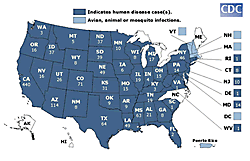
A: It is believed to have entered the U.S. in 1999 at New York City via an imported bird. Since then it has spread to all areas of the United States as well as into Mexico and Canada. Birds appear to be the main conveyor of the disease here.
Q: Can all mosquitoes transmit West Nile Virus?
A: No, two species, the Aedes aegypti and Culex pipiens mosquitoes appear to be two major vectors of West Nile Virus.
Q: Is the West Nile Virus fatal for all those who contract it?
A: No, although cases can become serious, here in the United States, with proper medical treatment, recovery can be expected. Interestingly, many researchers feel that others get mild cases of the disease, only exhibiting symptoms similar to the flu. Some people don’t get any symptoms at all and never realize they were infected with West Nile Virus!
Q: Besides, West Nile Virus, what other diseases can mosquitoes spread?
A: Mosquitoes are vectors (carriers) of Yellow Fever, Malaria, Dengue Fever, Dengue Hemorrhagic Fever, several forms of Encephalitis (St. Louis, La Crosse, Eastern Equine Encephalitis, Western Equine Encephalitis, Venezuelan Equine Encephalitis) in humans.
They also spread several diseases that affect pets and other animals including heartworm, hypersensitivity in cats, Avian influenza, Rift Valley Fever and Equine Encephalitis.
Answers to Frequently Asked Questions about Yellow Fever
Q: Where does Yellow Fever occur?
A: Yellow Fever, a viral mosquito-borne disease, has occurred mainly in Africa and South America, although cases have also been reported in the Caribbean Islands.
Q: Where does Yellow Fever get its name?
A: Yellow refers to the jaundice some people develop when they contract the disease. Jaundice results from liver deterioration or failure and can turn the skin and whites of the eyes a yellowish color.
Q: What is Yellow Fever and what are the symptoms?
A: It usually takes anywhere from 3 to 6 days after being bitten by the mosquito for symptoms to develop, if they develop at all. In milder cases, the person has no symptoms, but in more serious cases, the patient will develop typical flu-like symptoms associated with many other illnesses.
Q: Is Yellow Fever Fatal?
A: If the patient doesn’t improve within three to four days of the onset of the symptoms, they may begin to go through a “toxic phase” where fever redevelops, jaundice appears, external and internal bleeding occurs, and kidneys may begin to fail. Patients can also develop delirium, seizures, heart problems, and or lapse into a coma. Mortality rate is about 50% once patients have reached this point. Those that recover do not seem to have any debilitating consequences of the disease.
Q: How is it spread?
A: There are three words to describe how it spreads: monkeys, mosquitoes and humans. For example, a monkey having the disease is bitten by a mosquito who then transmits the disease to a human – this type usually occurs in the jungle in areas where people are working.
In some cases, the monkey is not part of the cycle. It can also be human to mosquito to human. These transmissions often cause large outbreaks in urban areas.
Q: Is there a vaccine for Yellow Fever?
A: Actually, there is a vaccine for this potentially fatal disease, but the number of cases keeps increasing. As people travel further, and human dwellings encroach on previously undeveloped lands, cases will continue to spread, reaching areas where it has never been a problem up to that point.
Answers to Frequently Asked Questions about Dengue Fever
Q: What is Dengue Fever?
A: Dengue Fever is a viral disease spread mainly by the Aedes aegypti mosquito. There are actually four viruses that cause the disease, and if infected, a person is believed to gain lifelong immunity from that virus and limited immunity to the other three Dengue Fever viruses.
Q: Where is Dengue Fever found?
A: Mainly in the tropical and subtropical regions of the world, including Central America, South America, Southeast Asia, Indonesia, parts of Australia and Africa.
However, it should be noted that more cases are being recorded in other parts of the world as people from unaffected regions travel to areas with Dengue Fever.
Q: What are the symptoms of Dengue Fever?
A: Symptoms of Dengue Fever include high fever, rashes, head and body aches (especially joint and muscular), nausea and vomiting. Lymph nodes may become swollen.
Q: Can people die from Dengue Fever? I’ve heard that it’s a deadly virus.
A: You are probably confusing it with Dengue Haemorrhagic Fever, which can be deadly. Dengue Fever itself is not deadly, and most of the symptoms generally last about a week.
Q: Are there cures or vaccines?
A: At this time there are no vaccines for Dengue Fever. Since it is a virus, antibiotics would be useless in fighting the virus. Usually people infected with the disease recover fully, unless complications occur. Contact your physician or health professional if you have traveled to an area known to have outbreaks of the disease and you come down with any of the symptoms listed above.
