
Mosquito Facts You Need to Know
Nobody really likes mosquitoes. In fact, these insects are considered humanity’s top enemy in the Wild Kingdom. This is because mosquitoes are considered “disease vectors ,” which means they’re often responsible for spreading deadly diseases to people. Although we can’t expect to fully eradicate these pests from our planet, there are ways to deal with them.
By using technology, repellents, insecticides and good old-fashioned common sense, we can help keep them away from our families and pets and prevent mosquito-borne diseases from spreading further throughout this world.
Let's take a closer look at some facts you may not know about these little pests!
MOSQUITO FACTS | MOSQUITO LIFE CYCLE | PREVENTING BREEDING
All About Mosquitoes
Mosquito Magnet® can help you learn all about mosquitoes in its articles section and learning center, and this list is just a sample of some of the mosquito information we have gathered to help home and business owners in their battle against these frustrating and deadly insects.
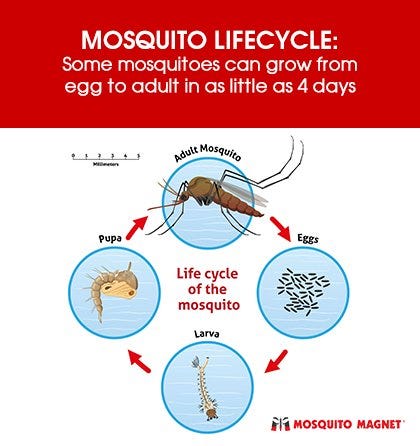
- GROWING UP: The mosquito can complete its life cycle from egg to adult in as little as 4 days, though most mosquitoes grow from egg to adult in about 2 weeks.
- TIME TO BITE: After only two days as an adult, a female mosquito is able to bite its first victim.
- WING SPEED: A mosquito’s wing beats up to 500 times per second.
- VIRUS HOSTS: West Nile Virus has been found in mosquitoes, birds, humans, and pets. More surprisingly, alligators and elephants have also picked up the virus.
- MORE THAN HUMANS: Mosquitoes also feed on reptiles and amphibians, including snakes, frogs and toads.
- WIDE VARIETY: Estimates for the number of mosquito species in the entire world range from 2,500 to 3,000.
- LIFESPAN: Most male mosquitoes only live for two weeks. Female mosquitoes often live up to a month or more, but they can certainly cause a lot of problems during that short time!
- HOUSING CHOICES: Some female mosquito species will lay their eggs in a tiny amount of water – including the ruts of a tire track, a small hole in a tree, the water dish at the bottom of a flowerpot, or even a discarded soda can.
- ON THE MENU: Both male and female mosquitoes feed on plant nectar for nourishment. Only the female mosquito bites people and animals to draw blood and obtain protein to properly develop her eggs.
- MOTHERLY DUTY: Female mosquitoes can lay up to 300 eggs at one time.
- TIME FOR WORK: Not all mosquitoes come out at dusk; the Asian Tiger Mosquito is known to bite mostly between the hours of 10am and 3pm.
- WINTER VACATION: Some types of female mosquitoes go into hibernation for the winter. Some larvae spend the winter in the mud of swamps.
- KILLER COUSINS: Some mosquito species’ larvae will eat other mosquito larvae.
- HITCHING A RIDE: Many mosquitoes have accidentally been introduced into the United States – the Asian Tiger Mosquito was imported in 1985 in some old tires that were shipped to the U.S. for recycling.
- ARE YOU SICK? A mosquito can infect a person with West Nile Virus but the person may never know it – not all people end up with symptoms.
- NOT A BACTERIA: Antibiotics do not work on mosquito-borne diseases because they are viruses. Antibiotics do not fight viruses.
- TOP KILLER: Mosquito-borne diseases kill more people worldwide than any other factor.
- WATER WORLD: In one way or another, mosquitoes’ lives revolve around water sources. All mosquitoes require water during their egg, larval, and pupal stage for maturation. As an adult, the female lays her eggs in the water.
- NOT-SO-FRIENDLY SKIES: The airline industry sprays its airplanes to eliminate any mosquitoes that hitched a ride on their planes. This practice is especially for planes coming from countries with outbreaks of mosquito-borne diseases.
- FINDING YOU: Mosquitoes do not have very good vision. They rely on the carbon dioxide you exhale in order to locate you.
- TEMPERATURE CONTROL: Mosquitoes usually do not bite when the temperature is less than 50°F. In fact, at these temperatures mosquitoes may slip into torpor.
- CLOSE TO HOME: Most mosquitoes remain near their breeding habitat as adults, although some are known to travel over 20 miles to find their “victims.”
- WEIGHT ISSUES No wonder we don’t feel them when they land on our arm -- most adult female mosquitoes weigh about 1/15,000 ounce or about 2.0 milligrams.
With Mosquito Magnet® CO2 mosquito traps, you can keep these dangerous mosquitoes away from your family and pets. This is the first step towards preventing the spread of mosquito-borne diseases.
[back to top]
Understand the Mosquito Life Cycle
Watch the amazing transformation of the Culex mosquito from egg to adult!
Mosquito Egg Stage
In the life cycle of mosquitoes, the egg, of course, is the first stage. Depending on the mosquito species, eggs may be laid individually or connected together to form a “raft” type of structure. The Aedes aegypti mosquito lays her eggs individually, while the Culex pipiens mosquito lays approximately 200 eggs which she unites to form a raft that floats just at the surface of the water.
Mosquito Larval Stage
In the life cycle of mosquitoes, mosquitoes in the larval stage are often referred to as “wigglers,” due to their movement in the water. Most larvae obtain oxygen through small tubes that reach the water’s surface. Other larvae lay adjacent to the surface to obtain oxygen. Some are able to obtain oxygen by fastening themselves to plants in the water.
During this stage, the larva goes through 4 different molts in which it sheds its exterior skin in order to grow bigger. The larva eats micro-organisms for the most part, although some mosquito specie’s larvae will actually feast on other mosquito larva species. When the larva has progressed through these four stages, it will have changed into a pupa.
Mosquito Pupal Stage
In the life cycle of mosquitoes, the pupal is the third stage. Mosquitoes in this transitional stage are referred to as “tumblers,” describing how they propel through the water. In this stage, the mosquito pupa rests without eating as it prepares to change into an adult mosquito.
Although they do “tumble” about in the water, this movement is mostly used to avoid danger. This stage of the life cycle of mosquitoes ends when the pupa’s outer membrane splits open and the adult mosquito emerges, usually within two days of entering this stage.
Mosquito Adult Stage
In the final stage of the life cycle of mosquitoes, the mosquito emerges from the pupal stage. Although the mosquito is an adult, it is not quite ready to take flight. It must wait, often hiding in vegetation, so its wings and body can fully dry, stiffen and finish developing. After a few days, it’s able to take flight and will begin searching for nectar, a mosquito’s actual food source. During this time, it will also seek out a mate.
Once mating is complete, the female will go in search of a blood meal and humans often become the target. For all mosquitoes, only adult females bite. She needs protein from blood to fuel the development of her eggs.
When she inserts her needle-like snout in her victim’s skin, the mosquito can transmit diseases to humans – and dogs, cats and horses. Such diseases include West Nile Virus, Malaria, Dengue Fever, Yellow Fever, Encephalitis of various kinds and Heartworm, to name a few.
Fortunately, the life cycle of mosquitoes is very short: males usually only survive for about two weeks, while a female can survive up to a month or more, giving her many opportunities to bite unsuspecting victims and deposit thousands of eggs. This prolific reproduction rate is the main reason why mosquitoes are such a serious threat – they reproduce so rapidly and spread diseases so quickly that the effect is very difficult to stop.
[back to top]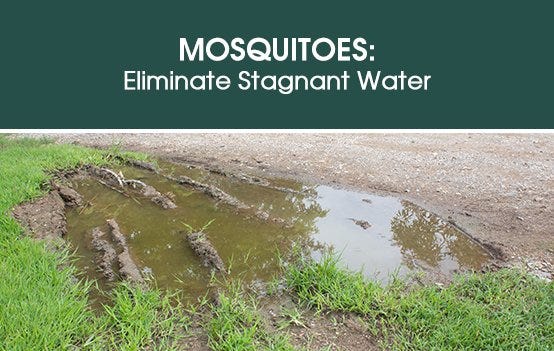
How to Prevent Mosquito Breeding
Probably the most effective way every person can combat the threat of mosquitoes is to eliminate standing water, the substance they need to incubate their eggs. By eliminating standing water in an area, you can significantly reduce the mosquito population in just a few weeks.
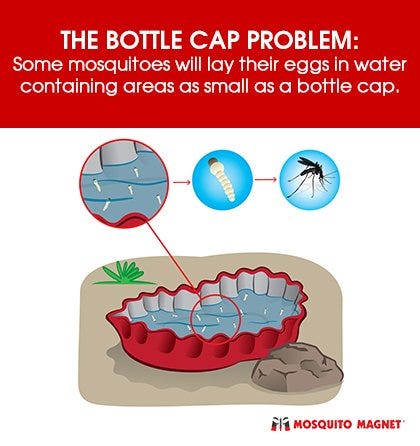
Common Mosquito Breeding Grounds
Standing water is more common than you may first believe. Look for and eliminate standing water found in these areas:
- Bird baths
- Old or temporarily stored tires
- Open containers, including cans, jars, bottles, cups or anything that can hold as little as an ounce of water. In fact, mosquitoes can leave eggs in as little as a drop of water. Even recycle bins may have some open containers that can collect water. Don’t forget those trash cans and trash can lids, too! Even a discarded plastic wrapper that manages to trap some water can hold mosquito eggs.
- Hollow trees
- Water gardens & ponds - Decorative ponds without fish. Other large areas of standing water
- Wading pools
- Drainage ditches
- Blocked or clogged rain gutters
- Pet food dishes
- Longstanding mud puddles and tire ruts
- Any area of standing water is a potential mosquito breeding ground!
Ways you can help eliminate mosquito breeding grounds
It’s up to you to keep your home and business mosquito free. With that in mind, try to take these steps to eliminate sites where mosquitoes can deposit their eggs.
- Dispose of old tires, buckets, ceramic pots and other containers on your property that collect rain water or pool morning dew.
- Fill in tree rot holes and hollow stumps that hold water.
- Drill holes into the bottom of tire swings.
- At least once per week, empty standing water from decorative containers, including birdfeeders, on your property.
- Drill holes in the bottom of outdoor recycling containers. Drainage holes in the sides of containers allow sufficient water to collect in which mosquitoes may breed.
- Clean clogged roof gutters, particularly if the leaves from surrounding trees have a tendency to plug up the drain to the downspout. Flooded roof gutters are easily overlooked but can produce hundreds of mosquitoes each season.
- Turn over plastic wading pools when not in use.
- Turn over wheelbarrows when not in use.
- Store boats covered or upside down, or drain rainwater inside them weekly.
- Aerate ornamental pools or stock them with fish. Water gardens are fashionable but become major mosquito producers if they are allowed to stagnate.
- Clean and chlorinate swimming pools that are not being used. A swimming pool that is left for a month can produce enough mosquitoes to infest an entire neighborhood. Be aware that mosquitoes may also breed in the water that collects on swimming pool covers.
- Keep drains, ditches and culverts free of grass clippings, weeds and trash so water will drain properly.
- Fill in low areas on your property to eliminate standing water. Ponds or streams where fish are present or the water is disturbed by current or wave action and do not produce many mosquitoes. However, standing water is more of a breeding area. So if you have mosquitoes, the standing water in your backyard has got to go. This will be the start of your anti-mosquito campaign!
Next step...effective outdoor mosquito control that can help you enjoy season-long protection from the dangers of mosquitoes!
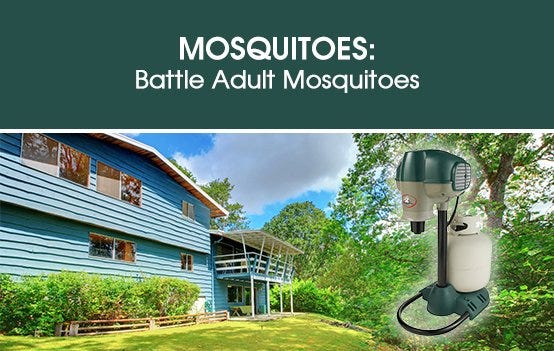
Getting Help from CO2 Mosquito Traps
Want to know more about how Mosquito Magnet® CO2 mosquito traps work? Or find out more about the threats mosquitoes pose? Try linking up with Mosquito Magnet® on Facebook, where we regularly feature fresh articles on using your trap and news about mosquito outbreaks.
If you’re considering investing in a trap, subscribe to the Mosquito Magnet® E-Newsletter, for links to helpful articles and other announcements. Finally, sign up for our reward points program, which gives you money back on future purchases.
[back to top]